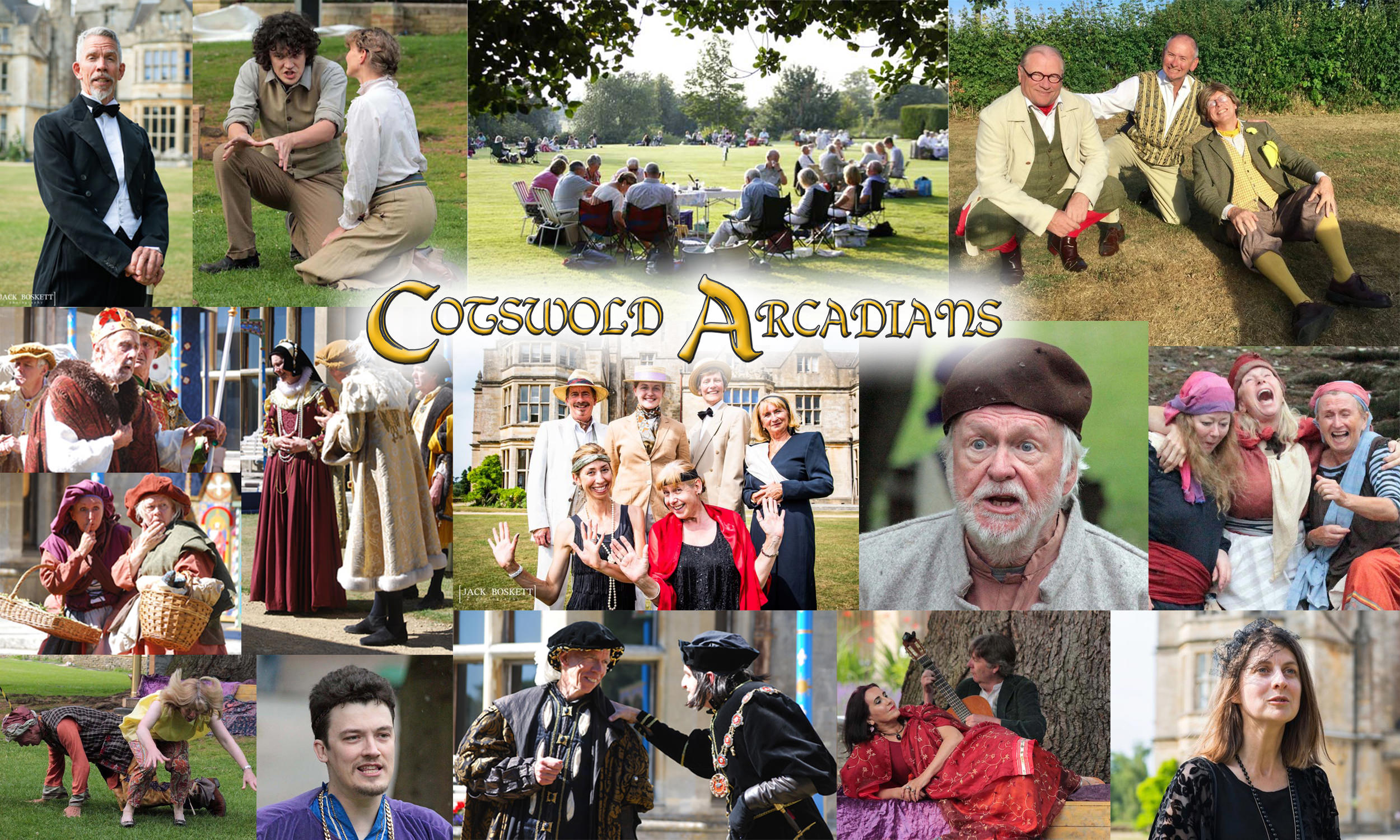
Cotswold Arcadians The Merchant Of Venice The Tempest King Lear Cotswold Arcadians A Midsummer Night's Dream Antony & Cleopatra Much Ado About Nothing Tickets! Tickets! Tickets!
Tickets
Box OfficeBOX OFFICE: 01285 711 714


Current Production
The Cotswold Arcadians

Previous Productions

Directors Wanted!


<< 2004: King Lear

~ Previous Productions ~

2005: A Midsummer Night’s Dream

Hatherop Castle

1595/6 is generally accepted as the period when A Midsummer Night's Dream appeared. Shakespeare was 31, an established member of the Lord Chamberlain's Men and had already written The Taming of the Shrew, A Comedy of Errors and Romeo and Juliet . The themes of mistaken identity, conflict and reconciliation again appear in The Dream.

A Midsummer Night's Dream


When Shakespeare was born in 1564 the monasteries, skilled in medical knowledge and the creating of potions, had been closed for a quarter of a century.  Yet such knowledge must have been passed on and certainly existed strongly in folklore.  Superstition abounded, witchcraft was feared and alchemy flourished.  Without doubt, Shakespeare's audiences were familiar with potions.  But love potions administered by the Immortals?  Within the context of his times Shakespeare was tweaking current familiar beliefs and practices.  And to enter a land of fantasy was an Elizabethan delight.  No wonder Samuel Pepys a century later described The Dream as "the most insipid, ridiculous play that I ever saw".

A Midsummer Night's Dream

The play opens with reconciliation after battle.  Theseus, the victor, is happy to marry Hippolyta, the defeated Amazonian Queen.  It is a dynastic union.  These are lofty, princely figures.  The energy, spirit and life are enshrined in the clumsy enthusiasm of the Mechanicals and the full-blooded spontaneity of the four lovers; Hermia, Helena, Lysander and Demetrius.

A Midsummer Night's Dream

A Midsummer Night's Dream

Yet all is not delight: Hermia is required to marry her father's choice of Demetrius as her spouse.  Disobedience will result in confinement in a nunnery or death according to Athenian law.  Only through conflict and misunderstanding — engineered by the impetuous elfine Robin Goodfellow — is harmony and understanding realised.  Even the Immortals Titania and Oberon are in dispute over the changeling Indian boy and the jealous accusation by Titania of Oberon's devotion to Hippolyta.


But the play is a comedy, and a thing as light as thistledown; there is reconciliation amongst the lovers, satisfaction amongst the Mechanicals that their play is "preferred", and Titania and Oberon unite in blessing the mortals' dwelling.

A Midsummer Night's Dream

* * *

Leave Us a Message!
We'd love to hear your comments
Leave Us a Message!


Sitemap
For further events & information in the Cotswolds, please visit: www.cotswolds.info
© The Cotswold Arcadians Ltd 2007